

Good Fortune Halal Certification
Official BPJPH Authorized Halal Certification Body
Halal Certification Support for Exporters in South & Southwest China
Halal certification support for exporters in Guangdong, Guangxi, Hainan, Sichuan, Chongqing, Yunnan, Guizhou and Tibet, covering application handling, audit arrangement and BPJPH certificate issuance
Product classification · Document review · On-site audit · Certificate issuance
This site serves enterprises in South and Southwest China; arrangements for other regions can be discussed during consultation.
Contact: +86 15165283950 / 18954218533 / 18954296933
Contact UsContact Information
If you have any questions or needs regarding halal certification, please feel free to contact us using the methods below and we will respond as soon as possible.
Contact Us
Address: Room 301, Yuanlin Building, No. 517, Zhujiang Road, Huangdao District, Qingdao, Shandong
Phone
Contact Phone: +86 15165283950
Email: fylhalal@halalcn.com
WeChat: Good Fortune Halal Certification

Our Certification Services
Warehousing and Logistics Certification
Warehouse environment inspection, transportation process monitoring
- Full cold chain monitoring ensures product halal integrity
Packaging Material Certification
Packaging material testing, contact material safety assessment
- Control from the source to ensure packaging meets halal requirements
Logistics and Distribution Certification
Transport vehicle inspection, delivery route planning
- Professional logistics team ensures safe product delivery
Halal Food Certification
Meat, dairy products, condiments, prepared foods, etc.
- Check formulation, ingredients and production lines against BPJPH requirements
Halal Beverage Certification
Juices, tea drinks, coffee, functional beverages, etc.
- Strict raw material audit ensures beverage halal compliance
Chemical Product Certification
Chemical raw materials, chemical products, additive compliance audit
- Strict audit standards ensure chemical product halal compliance
Halal Cosmetics Certification
Ingredient analysis, raw material verification, production environment assessment
- Comprehensive testing system ensures cosmetics purity
Halal Certification for Daily Necessities (Consumer Goods)
Sanitary pads, tissues, diapers, toys, tableware, dish soap, laundry detergent and other daily necessities
- Professional testing team ensures daily necessities halal compliance
Regional Industry Belts
Product scope, audit focus and application route by major export belt in South and Southwest China; companies spanning several belts are assessed product unit by product unit.
Guangdong: condiments, beverages, bakery and prepared foods
Soy sauce, oyster sauce, compound sauces, plant-protein drinks, bakery fillings and frozen prepared foods. The first screen is animal-derived flavour bases such as chicken powder, bone broth and gelatine; shared lines need production scheduling and cleaning records.
Guangxi: sugar, starch syrup and spices
White sugar, brown sugar, syrups, star anise, cassia and pepper. Focus on processing aids such as activated carbon, decolourisers and antifoam, plus mixed storage; bulk raw materials must be traceable to supplier batches.
Hainan: coconut products
Coconut milk, coconut powder, coconut oil and desiccated coconut. Look at press, refining and filling aids, shared equipment, and moisture and pest control in a humid climate.
Sichuan-Chongqing: hotpot bases and sour noodle products
Beef tallow or vegetable-oil hotpot bases, compound spices, starch noodles and seasoning packs. Key points are oil sources, animal-derived extracts and cleaning validation when several oils share one line.
Yunnan-Guizhou: tea, coffee and chilli products
Pu-erh and green tea, coffee beans and instant powder, chilli flakes and dipping sauces. Focus on shared equipment between primary and finishing lines, drying and roasting heat sources, and food-contact packaging.
Tibet: highland barley and dairy products
Highland barley flour and noodles, yak dairy and butter products. Explain raw-material sources, slaughter and milk-source management, and how high-altitude transport and storage affect quality records.
Pre-Application Checklist
Answer these six questions before deciding the scope and sequence of an application.
Exporter and certificate holder
Whether the factory or the trading company holds the certificate, and whether the Indonesian importer files on your behalf, changes the authorisation documents and later variations.
Product units and SKU scope
Divide units by formulation and line. Different pack sizes of one formulation can be combined; different oils or animal-derived bases cannot share one unit.
Formulation and ingredient traceability
Check additives, compound seasonings, processing aids and packaging item by item, and ask suppliers for composition and origin statements. Replace ingredients whose origin cannot be explained.
Shared lines and storage
Check whether equipment or warehouses are shared with pork-derived, alcohol-containing or non-halal animal-derived products. If so, a workable segregation and cleaning schedule is required.
Audit-day readiness
Production, quality control, warehouse and formulation management staff should be present on audit day and able to retrieve batch and cleaning records.
Port and documents
When shipping via Guangzhou, Shenzhen or Zhanjiang, certificate product names, manufacturer, customs declaration and packing list must match, so scope gaps are not found only on arrival.
Fee Structure and Compliance Boundaries
Quotes are itemised by actual scope rather than a vague lump sum.
Official BPJPH charges
Levied by BPJPH under its fee schedule, depending on the product units and certificate type applied for.
LHLN review fee
Covers document review, formulation and ingredient checks, audit arrangement and certificate issuance workload.
On-site audit travel
Auditor transport, accommodation and audit days, itemised by actual factory locations and the number of factories.
Fees consist of official BPJPH charges, LHLN review fees and on-site audit travel, subject to formal assessment; added products, added factories and renewal are assessed separately.
Compliance Boundaries
- The certification decision rests with BPJPH; the LHLN does not issue certificates on its own. Certificate scope and validity follow the approved decision.
- The company is responsible for the truthfulness of formulations, ingredient origins and production records; we do not supply or alter these materials on its behalf.
- A certificate covers only the approved product units. Products outside that scope must not carry the Halal mark or use the certificate number.
Significance of Halal Certification
Why Choose Halal Certification
Expand Muslim market
Align with Indonesian market access requirements across food, beverages and household products
Enhance product credibility
Gain trust from Muslim consumers and business partners
Meet international standards
Meet Indonesian BPJPH review and documentation requirements
Increase market competitiveness
Make product qualifications verifiable and traceable
Why Choose Good Fortune Halal Certification
Professional, authoritative, and trustworthy halal certification body
Good Fortune Halal Certification (GFHC) is an official BPJPH authorized halal certification service provider, offering warehouse, packaging, logistics chain, food, beverages, cosmetics, chemical products, and consumer goods certification. We are committed to providing authoritative and professional halal certification services for Chinese enterprises. Our certificates have legal validity for Indonesian customs entry, helping Chinese enterprises successfully enter the Indonesian market.
Our Mission
Promote the development of China's halal industry and help Chinese enterprises enter the international halal market
Our Vision
Become a long-term halal certification partner for exporters in South and Southwest China
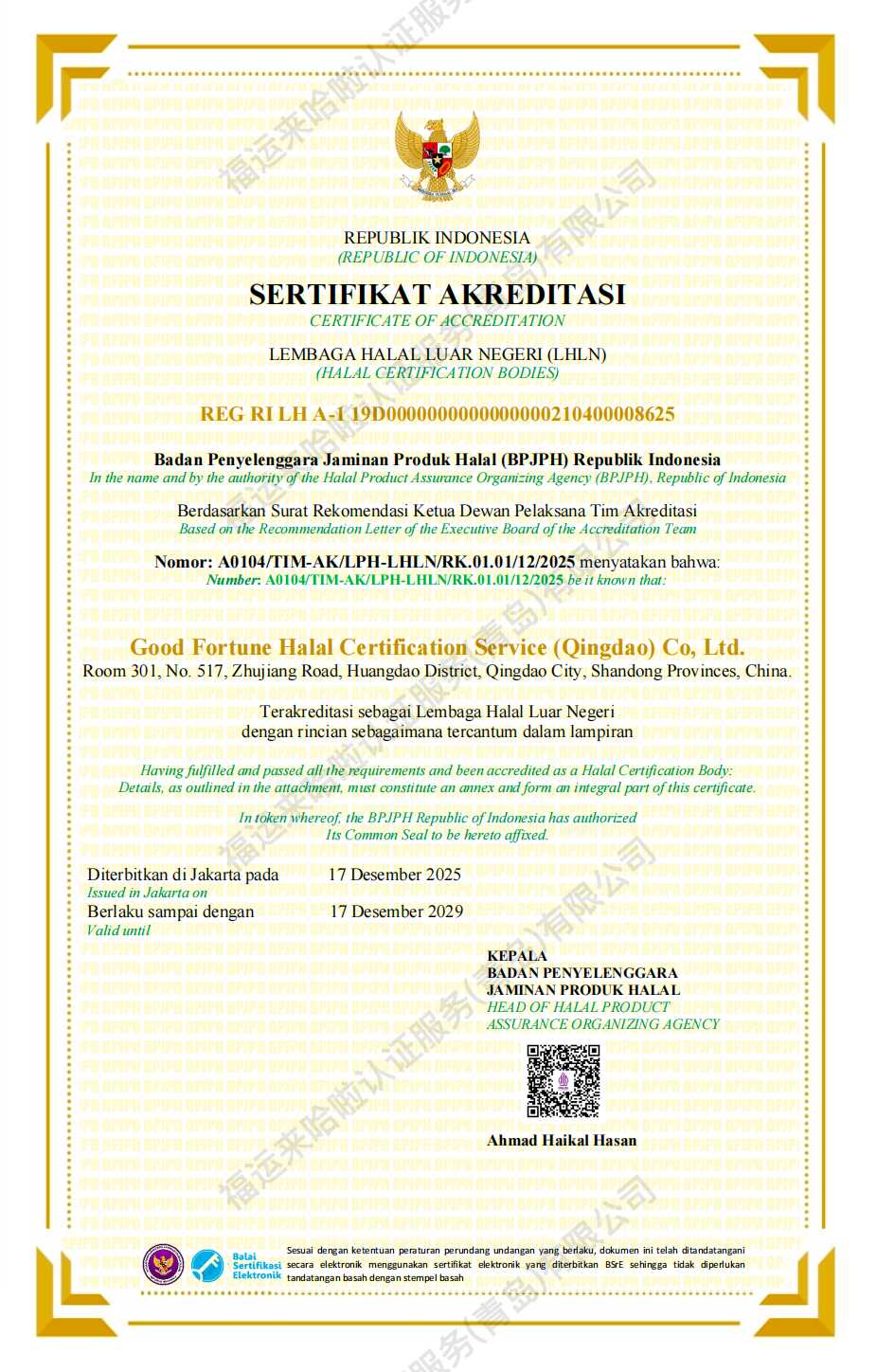
Indonesian BPJPH Official Authorization Certificate
Simple and Convenient Certification Process
Only six steps to obtain authoritative halal certification
Submit Application
Fill out the certification application form and submit relevant materials.
Document Review
Review the documents and product information submitted by the enterprise.
On-site Audit
Auditors conduct on-site inspection at the enterprise.
Certification Decision
Make certification decision based on audit results.
Certificate Issuance
Issue halal certification certificate after passing the audit.
Monitoring and Renewal
Conduct regular surveillance audits to ensure the certificate remains valid.
Industry News and Updates
Frequently Asked Questions
Common questions about Halal certification
Halal certification verifies that a product is free of non-compliant ingredients and cross-contamination across the whole chain, and the formula is only one part of that. Food manufacturers in Guangdong and neighbouring provinces often buy flavourings, fats and seafood extracts through several tiers of suppliers. If one supplier cannot evidence compliance, or batches cannot be matched, a clean formula still leaves the file incomplete. Reviewers normally expect the ingredient list, supplier documents, receiving batches and warehouse records to line up, so tracing first usually reduces rework.
View DetailsThe risk points differ by category. Condiments hinge on fermentation cultures, koji media, flavour enhancers and hydrolysed protein sources. Beverages hinge on flavouring carriers, colours, emulsifiers, process water and cleaning residues. Bakery products hinge on fats, dairy, leavening agents, improvers and shared baking trays. Many Guangdong plants run several brands in one park, so reviewers also look at scheduling and cleaning records to show halal runs were kept separate from non-halal runs.
View DetailsStorage is assessed on segregation and identification: whether halal raw materials, semi-finished goods and finished goods are physically separated from non-halal cargo, with dedicated locations and in/out records. Cold chain is assessed on temperature continuity and verified cleaning of shared rooms and doors. Transport is assessed on dedicated vehicles or verifiable cleaning, plus loading without mixed cargo. Zhanjiang exporters ship many batches and categories, so reviewers pay close attention to zoning of shrimp, fish and ingredients inside one cold store, and to agreements with outsourced cold stores.
View DetailsFor sugar products, the focus is on clarifying agents, decolourising agents and filter aids that may be animal-derived, plus whether molasses and syrups share storage with other materials. For spices, the focus is on primary processing at origin: whether drying, screening, cleaning, irradiation or fumigation uses non-compliant media, and whether sites or equipment are shared with animal materials. Guangxi star anise, cassia and cane sugar often come from cooperatives or primary processors, so reviewers expect the processing practices at those points to be described as well.
View DetailsCoconut milk, desiccated coconut and coconut water carry relatively low risk. Problems usually arise in compounding: emulsifiers, stabilisers, thickeners, preservatives and flavouring carriers. Tropical-fruit processing also uses colour-retention agents, acidity regulators, pectin and enzymes. Hainan plants often do contract manufacturing in small batches and multiple specifications, so before applying they should list the full composition of each compound additive, confirm suppliers can issue a halal status statement, and check whether the same additive comes from different suppliers across products.
View DetailsBeef tallow is the central risk point: reviewers check the fat source, rendering equipment and transport, to confirm no contact with non-compliant animal fats. Broad-bean paste raises questions about fermentation media, the primary processing of broad beans and chilli, and whether fermentation pits are shared with pastes containing animal material. Spices raise questions about primary processing and shared drying yards. Sichuan plants often run beef-tallow and vegetable-oil bases on one site, so reviewers expect an explanation of how equipment, containers and scheduling are kept apart.
View DetailsCompliance on a shared line rests on demonstrable segregation and cleaning: defined production windows for halal runs, a cleaning procedure performed after non-halal runs with verification records, and separated utensils, crates and personnel flow. For outsourced processing, duties belong in the contract, the contractor must accept equivalent review, and material origin, production and cleaning records must be available. Chongqing prepared-dish producers often make some steps in-house and outsource others, so reviewers trace the process step by step.
View DetailsTea and coffee raw materials carry relatively low risk; the review focuses on processing aids, cleaning chemicals and shared equipment. Pu-erh pile fermentation, screening and pressing, black-tea withering, fermentation and drying, and coffee hulling, roasting and grinding may all share equipment with products containing animal material. Retain equipment-use sequence, cleaning records, cleaning-chemical composition statements, and details of packaging materials that may contain animal-derived aids. Where sugar, creamer or flavourings are used for flavoured tea and instant coffee, the formula is reviewed item by item.
View DetailsFermented chilli and sour soup depend on fermentation: whether cultures or aged brine contain animal-derived material, whether fermentation vessels are shared with pastes containing animal material, and the origin of salt, alcohol and sugar used for pickling. Chilli oil depends on cooking oil, broad-bean paste, spices and flavour enhancers, especially whether animal fats enter the product. Guizhou plants often use both traditional clay jars and stainless tanks, so reviewers check that cleaning, sealing and batch records are consistent across both.
View DetailsIn practice, the first requests for certificates concern food and beverages consumed directly: condiments, instant foods, bakery products, confectionery, dairy and seafood products. Cosmetics, household chemicals and food-contact materials follow. The exact mandatory categories and dates should be checked against the latest BPJPH announcements, and exporters should confirm at quotation stage whether a product falls within scope. Where a product is in scope and no certificate is held, Indonesian buyers, platforms and customs clearance may all ask for supporting documents.
View DetailsCondiments are usually categorised as soy sauce, pastes, compound seasonings, hotpot bases and spice preparations; beverages as juices, tea drinks, plant-protein drinks, flavoured drinks and powdered drinks. Scope is not decided by category name alone but by actual product form, packaging and sales channel. The same formula supplied as a concentrate and as a powder may follow different filing routes. Exporters should confirm each item against the label and actual formula rather than grouping by industry habit.
View DetailsHalal certification and inspection/quarantine are separate systems and cannot substitute for each other. Seafood exports require registration, testing and health certificates under inspection rules; halal certification evidences compliance of materials, processing, storage and transport. Both should agree on material batches, production dates and factory registration details. A common problem in Zhanjiang and Zhuhai is a mismatch between the product scope on the halal certificate and the declared goods name, or an address change not reflected on the certificate.
View DetailsBeef tallow is animal fat, so reviewers must confirm its source, rendering and transport without contact with non-compliant animal material, and clear separation from vegetable oils. Hotpot-base formulas are complex: broad-bean paste, fermented black beans, yeast extract, meat-flavourings and umami agents may all contain animal-derived aids, and any unexplained item invites questions. Sour-spicy noodles involve a sauce pack, vinegar pack, oil pack and the noodle itself, and multi-pack products often miss one pack. Sichuan and Chongqing producers should list each pack separately, then combine them into one product description.
View DetailsWhether additional filing is needed depends on product form and use, not on the raw material name. Plain tea or unflavoured coffee beans follow a simpler route; flavoured tea, instant coffee, chilli sauce, chilli oil or compound seasoning enters formula review. Where a product is also used for cosmetic or health purposes, the corresponding category must be assessed. Exporters should judge each finished form of the same raw material separately rather than covering all SKUs under "tea" or "chilli".
View DetailsPlatform checks usually match the certificate number, product name and validity to each SKU. Shenzhen sellers often struggle because one listing covers several specifications while the certificate covers only some, or a supplier certificate describes the scope too broadly to match the listing title. Prepare an SKU list first, confirm the manufacturer and certificate behind each SKU, then check whether the certificate description covers what the listing shows. Where documents are incomplete, confirm with the supplier rather than substituting another product certificate.
View DetailsThe process normally runs through six stages: assessment and engagement, document preparation, document review, site audit, corrective action and verification, and certification decision and issuance. The company provides formulas, ingredient and supplier evidence, production and storage records, and arranges site escorts. The reviewing body conducts document review, the site audit and the report. The certification decision is made within the BPJPH system. Delays in South China most often occur in document preparation, which depends on suppliers, and corrective action, which depends on production scheduling.
View DetailsReturns are driven less by the formula sheet itself than by mismatches between formula and supplier evidence. Common cases include: an ingredient listed by trade name with no composition statement; an expired supplier statement or one covering a different category; the same ingredient supplied by different vendors across products but only one statement filed; and flavourings, compound additives or enzymes identified only by brand. Guangdong plants work through many supplier tiers, so build a four-column master table of material, supplier, evidence and applicable product, and check it before filing.
View DetailsAudits usually follow receiving, pre-processing, processing, cooking or freezing, packing, storage and dispatch. Seafood plants should open the receiving area, thawing and filleting rooms, cooking or freezing lines, packing area, cold store and container-loading area. Prepared-dish plants also show cooked/raw segregation, semi-finished holding and washrooms. Prepare an escort list, plant layout, the day production schedule and cleaning records in advance so what auditors see matches what was filed.
View DetailsSurveillance is scheduled within the certificate validity period; the exact frequency and timing follow the certificate conditions and the reviewing body notice. Start keeping routine records as soon as the previous audit closes rather than waiting for notice. Core records include incoming materials and updated supplier evidence, production batches and scheduling, cleaning verification for shared equipment, storage zoning and temperature control, and product changes or new SKUs. Export seasons in South China are pronounced, so avoid scheduling surveillance during shipment peaks.
View DetailsCost usually has three parts: BPJPH official fees, the LHLN review fee and site-audit travel, subject to formal assessment. Differences come mainly from the number of products and process complexity, the number and location of plants, whether remediation support is needed, document workload, and travel and accommodation for reviewers. Guangzhou and Chengdu differ in industry mix and plant scale, and labour and travel costs for the same category vary by city. Compare quotations only after aligning scope.
View Details